
How to get rid of an old air conditioner or dehumidifier in Massachusetts
Checked November 2026 · by JUNKRUN, Melrose MA
Air conditioners and dehumidifiers contain refrigerant, and Massachusetts includes every appliance that uses it in the white goods disposal ban. Federal law says the refrigerant must be removed before the appliance is discarded. Ask the dealer for haul-away, check your electric company and town program, or have it hauled with the refrigerant handled.
- In the trash?
- No. Every appliance with refrigerant is banned
- Federal rule
- Refrigerant removed before it is discarded
- Easiest route
- Dealer takes the old one with a new delivery
- Working unit
- Ask your electric company about take-back
- JunkRun
- $79 flat, freon recovery included
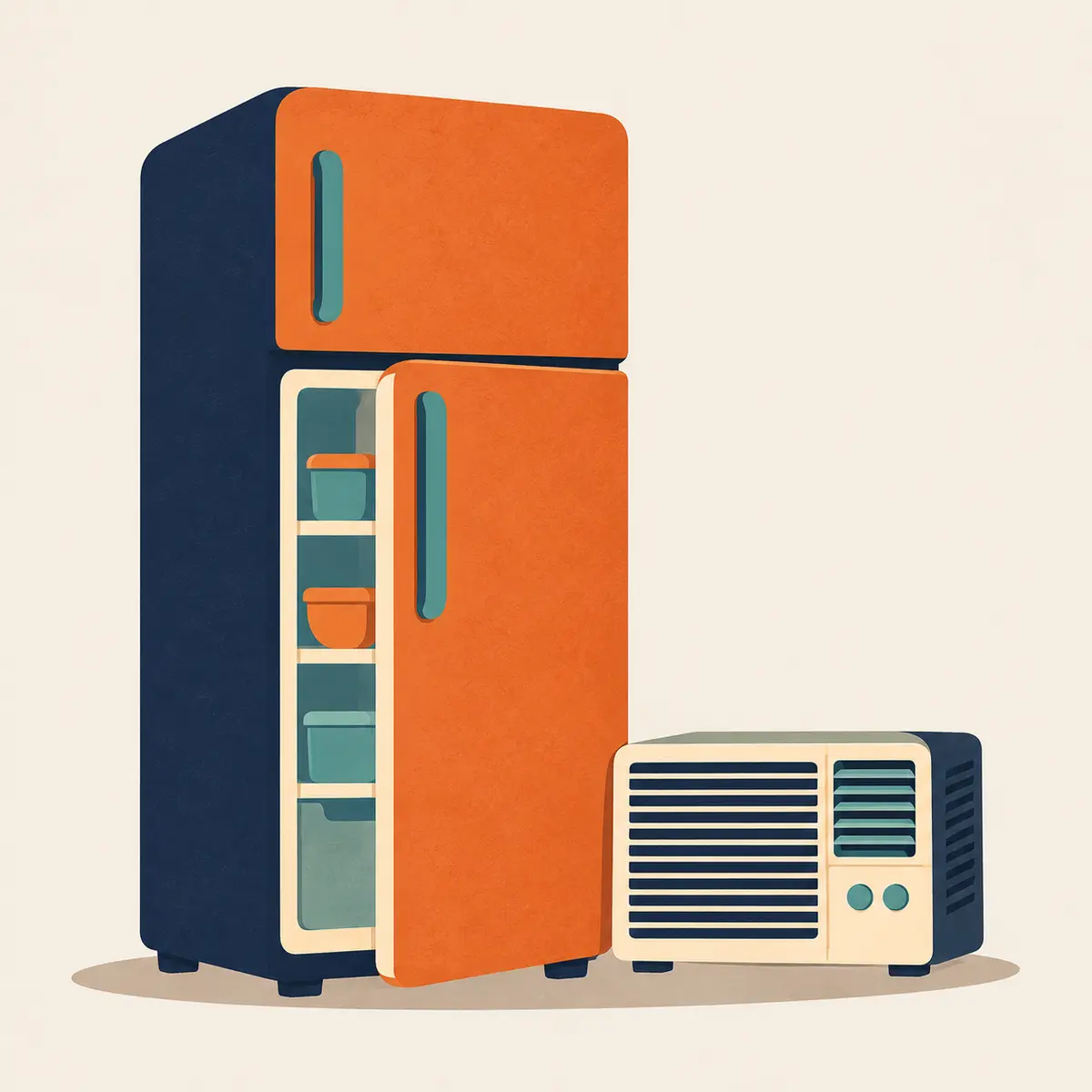
Is it banned from the trash?
MassDEP lists refrigerators, freezers, air conditioners and dehumidifiers as appliances containing chlorofluorocarbons (CFCs). The white goods ban covers them: all appliances using CFCs are included in this ban. See the MassDEP disposal ban list.
There is a federal rule too. Under federal law, CFCs must be removed before the appliance can be discarded. Until then, handle it in a way that does not damage the coils containing refrigerants: do not cut, crush or drop it.
Do this, in order
- 1
Unplug it. Do not bend, cut or crush it. The coils hold the refrigerant.
- 2
Buying a new one? Ask the seller about haul-away of the old one, and whether it is free.
- 3
Still works? Call your electric company about a take-back program, or donate it.
- 4
Check your town below for the transfer station or bulky-pickup fee.
- 5
Want it gone with no runs: book a pickup. Freon recovery is included in our price.
Your options, free to hauled
Cheapest first. Most people can stop at step one or two; the last step is for when you want it gone today.
- 1
Ask the seller to take the old one
FreeMost appliance dealers will remove old, unwanted appliances for free or at a small cost when delivering new appliances purchased from them. The offer is tied to a new appliance delivered by the dealer, so ask when you order whether it applies to a replacement you are carrying home yourself.
- 2
Call your electric company
FreeIf the unit still works, MassDEP says to call your electric company to see if they have a take-back program for high-demand appliances.
- 3
Use your town's appliance program
Low costMany towns take appliances at the transfer station for a fee or on a bulky-item pickup day. The table below shows what each town's own page says.
- 4
Use a freon-removal company or scrap dealer
Low costLook for a scrap-metal dealer that accepts white goods and ask for certification that CFCs are removed according to EPA protocol. Fees vary widely, so compare.
- 5
Have it hauled with the refrigerant handled
HauledJunkRun takes a window AC or dehumidifier as a small appliance at a flat $79, with freon recovery included. See the section below.
What towns charge for appliances
Most towns charge a per-appliance fee at the transfer station or at the curb. These lines come from each town's own page. For town fees and drop-off rules, see the refrigerator guide and the washer and dryer guide. Each of those guides has a table of what the towns we serve charge, with the town's own source link, and the dump and transfer station guide covers every town we serve.
A flat price, refrigerant handled
A window AC, mini fridge, microwave or dehumidifier is a small appliance: $79 flat, with freon recovery included, carried out from any floor with no stair fees. A washer, dryer or stove is $119, and a refrigerator or chest freezer is $149.
The minimum pickup is $159, so the best value is to bundle: the AC, the dehumidifier and anything else you want gone in one visit.
Small appliance (window AC, dehumidifier): $79. Standard: $119. Large: $149. Minimum pickup $159.
Edge cases
Can I take it to a scrap yard myself?
Only to one that takes white goods and can show the refrigerant was removed. MassDEP says to ask for certification that CFCs are removed according to EPA protocol, and that fees vary widely.
What about a car air conditioner?
CFCs must also be removed from car air conditioners before they can be scrapped. Ask the shop or scrapyard handling the car to confirm it is done.
Does a dehumidifier count the same as an AC?
Yes. Refrigerators, freezers, air conditioners and dehumidifiers contain chlorofluorocarbons (CFCs), and the ban covers all appliances using them.
I am a landlord clearing a unit with three window ACs. Any shortcut?
Book them in one pickup: three small appliances at $79 each is one visit, and the $159 minimum is already covered.
Quick answers
Can I put a window air conditioner out with the trash?
+
No. Air conditioners contain refrigerant and fall under the Massachusetts white goods ban. Federal law requires the refrigerant to be removed before the unit is discarded.
Does the dealer take my old air conditioner?
+
MassDEP says most appliance dealers will remove old appliances for free or a small fee when delivering new ones bought from them. A unit you carry out of the store yourself is a different case, so ask.
What about a dehumidifier?
+
Same rule. MassDEP lists dehumidifiers with air conditioners and refrigerators as appliances containing CFCs.
How much does JunkRun charge to take an AC or dehumidifier?
+
A small appliance, which includes a window AC or dehumidifier, is a flat $79 with freon recovery included. The minimum pickup is $159.
Sources
Checked November 2026. Programs and fees change, so confirm anything time-sensitive with your town.
- MassDEP: Guide to Safely Managing Hazardous Household Products: “Appliances such as refrigerators, freezers, air conditioners and dehumidifiers contain chlorofluorocarbons (CFCs)”
- MassDEP: Guide to Safely Managing Hazardous Household Products: “All appliances using CFCs are included in this ban.”
- MassDEP: Waste disposal bans: “Materials Currently Banned from Disposal or Transfer for Disposal in Massachusetts”
- MassDEP: Guide to Safely Managing Hazardous Household Products: “Under federal law, CFCs must be removed before the appliance can be discarded.”
- MassDEP: Guide to Safely Managing Hazardous Household Products: “Handle in a way that does not damage coils containing refrigerants.”
- MassDEP: Guide to Safely Managing Hazardous Household Products: “Most appliance dealers will remove old, unwanted appliances for free or at a small cost when delivering new appliances purchased from them.”
- MassDEP: Guide to Safely Managing Hazardous Household Products: “call your electric company to see if they have a take- back program for high-demand appliances”
- MassDEP: Guide to Safely Managing Hazardous Household Products: “Ask for certification that CFCs are removed according to EPA protocol.”
- MassDEP: Guide to Safely Managing Hazardous Household Products: “CFCs must also be removed from car air conditioners before they can be scrapped.”