
How to get rid of construction and renovation debris in Massachusetts
Checked November 2026 · by JUNKRUN, Melrose MA
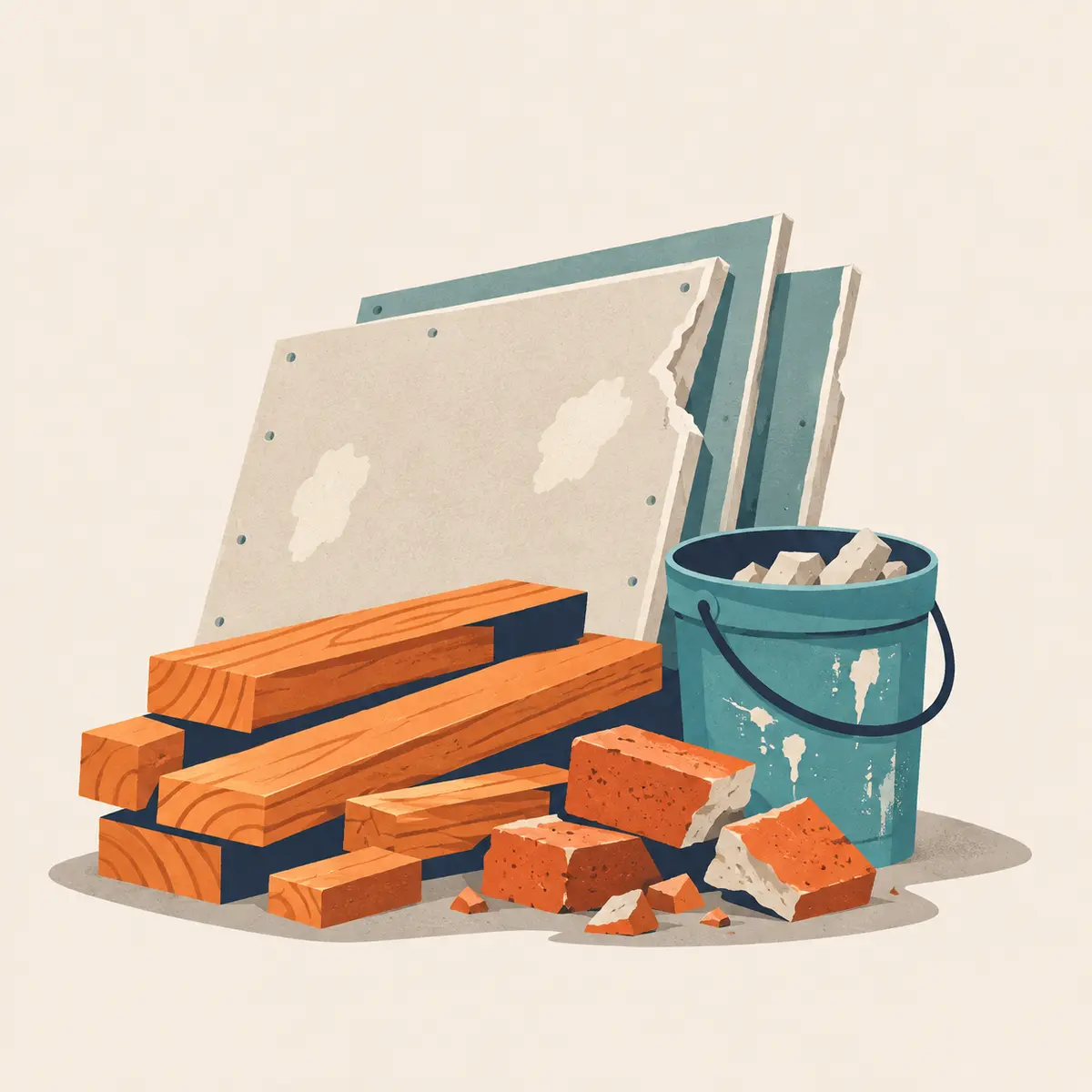
Short answer. Asphalt, brick, concrete, metal, wood and clean drywall are banned from disposal in Massachusetts, so renovation debris has to go to a construction-and-demolition (C&D) recycler. Towns almost never take it at the curb or a drop-off, and the one transfer station on our list that does charges by weight ($260 per ton for building and demolition debris in Winchester). Your options are a dumpster, a contractor who hauls it, or a junk crew priced by the trailer load: $209 for a quarter trailer, $159 minimum.
The Massachusetts rule
MassDEP says the C&D ban covers asphalt pavement, brick, concrete, metal, wood and clean gypsum wallboard. The ban on asphalt pavement, brick, concrete, metal and wood took effect July 1, 2006, and the ban on clean gypsum wallboard July 1, 2011. Wood is banned from landfills only: MassDEP notes it may still go to municipal waste combustors. The same list appears in MassDEP's waste ban table. Winchester repeats the point: large quantities of clean gypsum wallboard are banned by the state and must be recycled at a C&D facility.
For a homeowner the rule is mostly invisible: it binds the facility and the hauler. In practice, mixed debris cannot go out with the trash, and a hauler has to take it to a facility that sorts or recycles it, which is why it costs more than household junk.
Asbestos is not ordinary debris. Reading's page says to use a licensed asbestos removal contractor. If a house is old and you are unsure, have the material tested before demolition.
Free or cheap options
- Reuse and donate. Habitat's Greater Boston ReStore takes building materials: cabinets, doors and windows (new), tile (100 square foot minimum), lumber (drop-off only) and new shingles (10 bundles or more). It is the free option for intact materials from a kitchen redo. It does not take brick, pavers, countertops or used fiberglass insulation (the "donate elsewhere" list). Reading also points to the Building Materials Resource Center, (617) 442-2262, for good used and surplus building materials.
- The contractor. Reading's rule is explicit: the contractor completing the work should remove the debris; the town names a private facility in North Andover (Thomson Brothers Industries, 210 Holt Road) that takes non-hazardous construction and demolition debris for a fee. Put debris removal in the contract.
- Dumpster rental. A roll-off is the standard for a whole-room renovation. Many towns require a permit; check with your town before it is delivered (see the dumpster permit guide).
- Transfer station by weight. Winchester charges $260 per ton for building and demolition debris (pieces under 42 inches long), with a $15 minimum scale charge, for residents with a permit. The other towns we checked do not take it.
What towns do and do not take (checked November 2026)
- WinchesterConstruction debrisTransfer Station, $260 per ton, max 42 in. length; resident permitSource
- ReadingConstruction debrisNot accepted curbside; contractor removes; private facility namedSource
- SaugusConstruction debrisCHaRM Center does not accept construction debris, lumber, concrete or sheetrockSource
- BostonConstruction debrisConstruction material is not on the special-collection list; the city points to donation or a private haulerSource
- PeabodyConstruction debrisRecycling center does not accept construction materialSource
- LynnConstruction debrisThe Covanta transfer station no longer accepts wood or construction debris; the DPW page lists private recyclersSource
- StonehamConstruction debris"Items requiring special arrangements": wood, construction/demolition, concrete and brick; contact Casella, 1-800-950-9293Source
- MedfordConstruction debrisBuilding and demolition materials (lumber, concrete, brick, doors, windows) not accepted in bulky pickupSource
For other towns, ask your DPW. Most will point you to a contractor, a dumpster or a private recycler.
DIY or hauled?
DIY: a pickup load of drywall, lumber and a few buckets is workable if you have a place that takes it. Weight is the catch: concrete and brick fill a truck by weight long before volume, and a fee by the ton adds up quickly. Keep clean wood and clean drywall separate; mixing is how a load gets refused.
Hauled: any job more than a few bags or a vehicle load, and any renovation where debris is mixed. A junk crew prices by the trailer and loads it for you, which beats a dumpster you have to fill yourself when the job is a basement or garage gut. Ask about heavy masonry (concrete, brick, dirt) before you book, since weight, not space, limits it.
What JunkRun charges (posted flat prices, junkrun.co/pricing)
Priced by the load, not by weight or material:
- Box / bagJunkRun price$11Sizeeach
- ¼ trailerJunkRun price$209Sizeabout 3 cu yd
- ½ trailerJunkRun price$319Sizeabout 6 cu yd
- ¾ trailerJunkRun price$409Sizeabout 9 cu yd
- Full trailerJunkRun price$519Sizeabout 12 cu yd
$159 minimum pickup. JunkRun's own FAQ says renovation debris is "fair game" while hazardous waste such as asbestos is never on the truck; ask about concrete or brick first.
Related
- Dumpster permit by town
- Massachusetts waste bans
- Basement cleanout cost in Massachusetts
- Back to the hub
Quick answers
Can I put construction debris in my regular trash in Massachusetts?
+
No for most of it. Asphalt, brick, concrete, metal, wood and clean gypsum wallboard are banned from disposal, and the towns we checked do not collect renovation debris at the curb.
Where can I drop off construction debris?
+
Winchester's Transfer Station takes it at $260 per ton, residents with a permit only. Reading names a private facility in North Andover. Otherwise use a dumpster or a hauler.
Does the contractor have to take the debris away?
+
Reading's rule is that the contractor doing the work should remove it. Put it in the contract either way.
Can I donate leftover building materials?
+
Yes, in good condition. Habitat's ReStore takes cabinets, tile, lumber and new doors and windows, not brick, pavers or countertops.